No results have been found.
Introduction
Welcome to the HealthData@EU Documentation
This space provides a comprehensive overview of the HealthData@EU Central Platform, the official EU platform enabling the secondary use of health data across borders.
Here, you will find:
- An introduction to the HealthData@EU Central Platform and its role in implementing the European Health Data Space (EHDS) Regulation.
- A description of the main components and services, including interoperability mechanisms, data access workflows, and security features.
- Guidance for Member States, EU bodies and other authorised users on how to connect, exchange metadata, and manage data access applications or data requests.
- Details on the open-source modules, technical architecture, and compliance with EU standards such as DCAT Application profile for data portals in Europe (DCAT-AP).
Whether you are a policymaker, developer, health data access body, or simply curious about the European health data infrastructure - this page will help you understand how the system works, how to engage with it, and where to go for further technical resources.
This platform is under active development. Contributions are encouraged to help shape its future development.
The HealthData@EU Central Platform is developed by the European Commission under the European Health Data Space Regulation. It is open-source and progressively rolled out in close cooperation with Member States and partners.
HealthData@EU Central Platform
This is the core technical component of the HealthData@EU cross-border infrastructure supporting secondary use of health data under the EHDS.. It is displaying the EU-wide dataset catalogue that prospective health data users can use to find datasets for secondary use from holders all over the EU. It also provides a common application form that applicants can use to submit multi-country applications. The infrastructure will then forward the application to the relevant national contact points (who will then distribute it to the competent health data access bodies (HDABs) or to the relevant authorised participant. It will also provide tools for the cooperation between HDABs, for example so that they can share information on penalties imposed.
The HealthData@EU Central Platform is developed by the European Commission’s Directorate-General for Health and Food Safety (DG SANTE) to implement the European Health Data Space (EHDS) Regulation.
The development of the platform is organised in incremental releases, which started in September 2023 and will finish in mid-2027 with enabling all the services requested in the EHDS Regulation. (
Since March 2025, the platform is available as open-source software, allowing Member States and authorised participants to reuse and adapt the components according to their national or institutional needs. All source code, documentation, and configuration files are publicly available.
Open-source modules
The table below presents a brief description about each module available in the HealthData@EU Central Platform open-source repository. Community users should follow the starter-kit to install and deploy every component and have the entire system up and running on a local environment.
However, based on user specific needs, each module can be installed independently and used with existing national solutions (with some technical adaptation required).
| Module | Description |
|---|---|
| hdeu-starter-kit | Step by step, detailed guide to prepare, download, install and run a local instance of HealthData@EU Central Platform. |
| hdeu-hub-UI | Uses Europa Component Library (ECL) style and components, Content Management System, and is translated to 27 EU languages. Front-end implementation for all the features not included in the CMS. Basket, My Applicant Space, Applications, front-end for full applications lifecycle management, European Registry. Reporting and Monitoring (including Statistics and Biennial Reports), Implementation Support (including Dataset Description Assistant and Metadata Model Explorer), SPARQL included in the EU Dataset Catalogue. |
| hdeu-cms | USER INTERFACE CONTENT MANAGEMENT SYSTEM Responsible for generating and maintain static pages of HealthData@EU Central platform, adding dynamic HTML generation and facilitating content update. |
| hdeu-hub-store | FILE STORAGE BACK-END Manages file storage and retrieval for the platform. |
| hdeu-hub-repo | REPOSITORY FOR DATASET RECORDS CATALOGUING BACK-END Responsible for managing metadata, synchronising with the search. |
| hdeu-hub-search | SEARCH ACROSS DATASET RECORDS BACK-END It enables search, filtering, and integration with multiple data catalogues. |
| hdeu-hub-access | MANAGEMENT OF DATA APPLICATIONS BACK-END Application lifecycle: creation, data validation, back-end basket management, status monitoring. Handling full application lifecycle management, including decisions (positive and negative), appeals, Data permit issuing and amendments, and rules for application annexes and formulars eTranslation |
| hdeu-dispatcher | eDelivery and dispatcher implementation, which act as an intermediary between the Data Access and Hub‑Repo modules. |
| hdeu-hub-statistics | STATISTICS BACK-END Gathers and processes statistics on dataset records. |
| hdeu-ITB | INTEROPERABILITY TEST BED Implementation of HealthData@EU Interoperability Test Bed instance for internal central platform tests and allowing for member states autonomous connectivity and conformance tests with Central Platform. |
| hdeu-auth | AUTHENTICATION AND AUTHORISATION BACK-END Provides integration with EU Login for authentication and Keyclock for authorisation. |
| hdeu-hub-translation | eTRANSLATION OF DATASETS AND APPLICATIONS BACK-END Preforms translations of Files, Dataset records, and Data Applications using eTranslation. |
| Health DCAT-AP | HEALTH DCAT-AP TECHNICAL SPECIFICATIONS UPDATED for Release 7 Introduction of a mandatory property indicating whether a dataset is structured or not. New controlled vocabularies for the “conformsTo” and “hasCodingSystem” properties. “Variables” property was moved from the Sample distribution level to Dataset level, supporting the description of dataset content (data dictionaries for structured datasets). |
| hdeu-email | Responsible for sending emails |
Health DCAT Application Profile
A key feature of the HealthData@EU Central Platform is the EU Dataset Catalogue, which allows users to search for health datasets available for secondary use based on structured metadata.
To ensure standardised and interoperable metadata, the EHDS Regulation empowers the European Commission to adopt an implementing act setting out the minimum elements that data holders must provide when describing datasets. These elements will form the basis of a dedicated Health extension of DCAT-AP - the Health DCAT-AP.
Health DCAT-AP is being developed by DG SANTE, in collaboration with the Semantic Interoperability Centre Europe (SEMIC), the Publications Office, and expert stakeholders. It will be maintained by the European Commission and aligned with the general DCAT-AP framework managed under EU Interoperability Guidelines.
DG SANTE’s overall work on Health DCAT-AP specifications preparation is a complex task and consists of number of actions, such as:
- Work with experts on defining new health specific metadata types.
- Establish and manage the governance mechanism for the metadata specification’s maintenance.
- Establish the metadata specifications compliant with DG DIGIT guidelines for extensions of DCAT-AP.
- Create and maintain the Health DCAT-AP technical specifications, constraint files, controlled vocabularies, and validation tools.
To support Health DCAT-AP implementation DG SANTE developed and made publicly available:
- Health DCAT-AP validator.
- Health DCAT-AP Metadata Model Explorer. The interactive tool which offers a visual and user-friendly reference to help users apply the Health DCAT-AP specification. It displays definitions, cardinalities, usage notes, and RDF examples for each metadata element.
- Health DCAT-AP Dataset Description Assistant. An intuitive interface designed to support data holders in producing structured and compliant dataset descriptions, in line with the Health DCAT-AP specification. By guiding users through a dynamic form adapted to the dataset’s access rights, the Assistant ensures high metadata quality, consistency, and regulatory alignment.
Data Access and Data Request Applications
The health data applicant should provide health data access bodies with several elements of information that would help the body evaluate the health data access application and decide if the health data applicant can receive a data permit, and coherence should be ensured between different health data access bodies. The information provided as part of the health data access application should comply with the requirements established under the EHDS Regulation to enable it to be thoroughly assessed, as a data permit should only be issued if all the necessary conditions set out in the EHDS Regulation are met.
In order to ensure uniform conditions for the implementation of the EHDS Regulation, implementing powers are conferred on the Commission as regards templates for the health data access application, the data permit, and the health data request.
Therefore, the HealthData@EU Central Platform in each Release implements the templates for the harmonised applications, which are the outcome of the member states work, and which undergo continues improvement.
To access health data for secondary use, applicants must submit a structured application to the relevant Health Data Access Body (HDAB). The application must contain a set of predefined elements that allow the HDAB to assess the request and determine whether to grant a data permit.
In line with the European Health Data Space Regulation (EU) 2025/327, all applications must comply with common EU-level requirements, ensuring consistency and comparability across Member States. The content and structure of these applications are defined through implementing acts adopted by the European Commission.
To support this framework, the HealthData@EU Central Platform integrates harmonised application templates for:
- Data access applications
- Data requests
- Data permits
These templates are developed in collaboration with Member States through the EHDS2 Pilot project and the TEHDAS2 Joint Action (Second Joint Action Towards the European Health Data Space) . They are continuously improved with each platform release. They aim to streamline the process for both applicants and evaluators, promote transparency, and ensure compliance with the EHDS legal framework.
Filling in and sending Data Access and Data Request Applications
The HealthData@EU Central Platform provides a streamlined workflow for submitting applications to access health data across Member States.
Here is how the process works:
- The applicant searches the EU Dataset Catalogue hosted on the platform to identify relevant Metadata records. Once selected, these records are added to a virtual "basket."
- After logging in via EU Login, the applicant goes to the basket and selects the type of application to create:
- Data Access application (for obtaining individual level data)
- Data Request (for requesting aggregated information)
- The platform automatically pre-fills the application form with metadata from the selected datasets. The applicant must complete all mandatory fields across the structured sections of the form.
- Once completed and translated, the application can be submitted in one click to all relevant Member States - i.e., those who published the selected datasets.
- The application is automatically routed to the National Contact Point for Secondary Use (NCP-SU) of each concerned Member State. The NCP-SU forwards it to the competent Health Data Access Body (HDAB).
- The HDAB evaluates the application and issues a decision. The result (approval or refusal) is returned via the same channel: HDAB → NCP-SU → Central Platform.
- The applicant is notified through the platform.
- If the application is approved, a data permit is granted, and the applicant can access the requested data under the conditions specified in the permit.
Who can apply for access to electronic health data for secondary use
According to the EHDS Regulation, Health Data Access Bodies shall only grant access to electronic health data for secondary use to a health data user where the processing of the data by that health data user is necessary for one of the following purposes:
(a) the public interest in the areas of public or occupational health, such as activities to protect against serious cross-border threats to health, public health surveillance or activities ensuring high levels of quality and safety of healthcare, including patient safety, and of medicinal products or medical devices.
(b) policy-making and regulatory activities to support public sector bodies or Union institutions, bodies, offices or agencies, including regulatory authorities, in the health or care sector to carry out their tasks defined in their mandates.
(c) statistics as defined in Article 3, point (1), of Regulation (EU) No 223/2009, such as national, multi-national and Union-level official statistics, related to health or care sectors.
(d) education or teaching activities in health or care sectors at vocational or higher education level; PE-CONS 76/24 189 LIFE.5 EN.
(e) scientific research related to health or care sectors that contributes to public health or health technology assessments, or ensures high levels of quality and safety of healthcare, of medicinal products or of medical devices, with the aim of benefiting end-users, such as patients, health professionals and health administrators, including:
(i) development and innovation activities for products or services;
(ii) training, testing and evaluation of algorithms, including in medical devices, in vitro diagnostic medical devices, AI systems and digital health applications.
(f) improvement of the delivery of care, of the optimisation of treatment and of the provision of healthcare, based on the electronic health data of other natural persons.
User Identification and Authentication (EU Login)
The EU Login implementation allows for user authentication in the HealthData@EU Central Platform, as several platform services are only available to logged-in users.
- Adding dataset distributions to the basket for later creation of Data Access Applications or Health Data Request Applications.
- Initiating, filling in, saving, editing, and sending the Data Access Applications or Health Data Request Application.
- Verifying the status of ongoing or submitted applications.
- Receiving the final decision for the submitted application.
- Accessing the Administration Panel (administrator privileges required).
To create an EU Login account please navigate to this page .
Europa Component Library
The Europa Component Library (ECL) is a comprehensive style guide containing the design elements and visual standards that make up all Europa websites and applications.
The name Europa Family covers all digital content managed by the European Commission, and contains:
- European Commission websites hosted under the ec.europa.eu domain
- European Union websites hosted under the europa.eu domain
HealthData@EU Central Platform is a European Union hosted website under the europa.eu domain and fully compliant with ECL version 4.
Find more about ECL v4 here . All library elements are accompanied by:
- documentation explaining what a component is and how it should be used
- a visual demonstration
- HTML/CSS code for implementation
European Health Data Space interoperability with other data spaces
As part of the European Strategy for Data, the European Health Data Space (EHDS) is designed to be interoperable with other Common European Data Spaces, enabling secure and reusable data flows across sectors.
This ambition was explored in the SIMPL-Live project led by DG CNECT, which assessed how the Simpl: Cloud-to-edge federations empowering EU data spaces framework could support integration across six flagship data spaces:
- Public Procurement Data Space
- European Health Data Space (secondary use)
- Language Data Space
- European Open-Source Cloud Initiative
- Destination Earth
- Smart Communities Data Space
The study focused on three core aspects:
- Identifying common technical and governance requirements across the data spaces.
- Defining specific functional and non-functional needs per sector.
- Proposing integration strategies for each data space.
Within this analysis, the EHDS was recognised as a pioneer implementation, with a functioning technical infrastructure (the HealthData@EU Central Platform) and operational open-source components already in place.
SIMPL is expected to reuse, where appropriate, components developed by EHDS, and to ensure that its future developments remain interoperable with the existing EHDS infrastructure. This approach ensures coherence, avoids duplication of effort, and strengthens the EU’s interoperable data ecosystem.
HealthData@EU Conceptual Architecture
The aim of the HealthData@EU Central Platform is to provide a multilingual and fully accessible system fulfilling the requirements of the European Health Data Space Regulation. Where services relevant to the enabling the process of secondary use of health data, such as:
- Searchable EU Dataset Catalogue, where everyone can find the information about all the datasets available for secondary use of data.
- Filling in and submitting the Data Applications regarding the dataset records chosen from the
- Creation of the Dataset Catalogue, which is an aggregation of national metadata catalogues compiled from metadata records, made available by the data holders.
- Health Data Access bodies assessment of the Data Applications submitted in the HealthData@EU Central Platform.
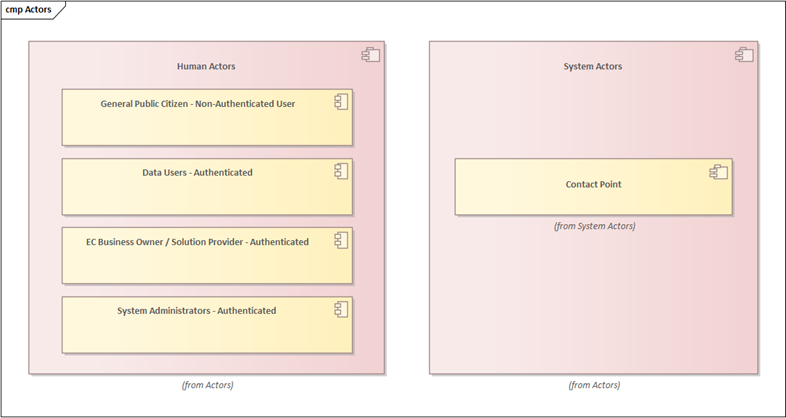
Actors
This section describes the actors interacting with the HealthData@EU Central platform. These can be human actors or system actors:
Conceptual Components
- HealthData@EU Central Platform - The core platform operated by the European Commission.
- HealthData@EU Infrastructure - The secure message exchange network.
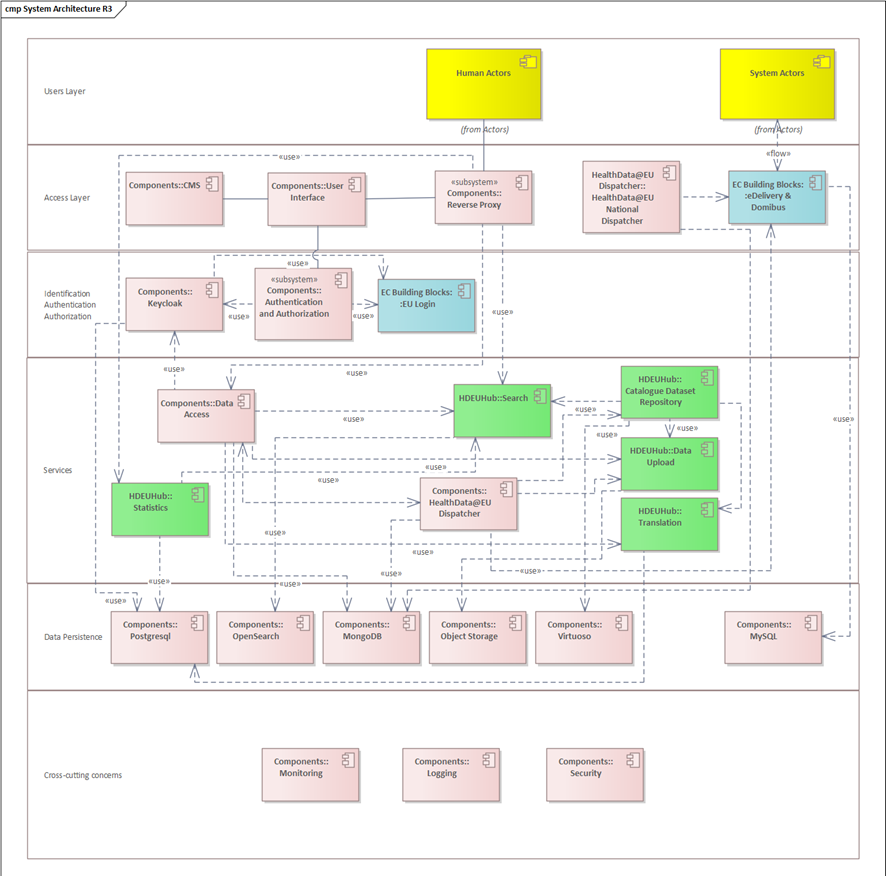
HealthData@EU System Architecture
The software architecture is designed as a modular microservices system with RESTful APIs, enabling flexible integration, horizontal scalability, and maintainability.
Architecture Layers
The system architecture consists of six layers distributed by two components:
HealthData@EU Central Platform
User Layer
The user layer encompasses the actors of the platform.
- Data users, General Public, and Administrators which use the platform, mainly through its User Interface.
Access Layer
The Access layer is the entry point into the platform, allowing users to access its functionalities
- Reverse Proxy
- The reverse proxy is responsible for proxying the requests to the appropriate components.
- User Interface
- The EU Dataset Catalogue user interface is based on the Piveau-Hub following the ECL library.
- Applications user interface is a custom development following the ECL library
- CMS (Content Management System)
- The CMS enhances the User Interface by providing static pages that can be edited via Drupal.
Identification, Authentication and Authorisation Layer
- EU Login
- The EU Login service. It is the user authentication service of the European Commission, providing a single, secure way for authenticated internal and external users to access various Commission web services and information systems.
- Keycloak
- The Keycloak application that stores the authenticated users along with their authorisation. An EU Login is configured on Keycloak so it can validate EU Login issued tokens before performing a token exchange.
Services Layer
- HealthData@EU Catalogue Dataset Record Repository
- This component is derived from the Piveau-Hub Repository. Its purpose is to manage Dataset Catalogues, Dataset Records, and their Distributions. It is the entry point of the HealthData@EU Central Platform for incoming datasets records from the National Access Points. It uses the Piveau Search to index the data and Piveau Data Upload to store them.
- HealthData@EU Search
- This component is derived from the Piveau-Hub Search. Its purpose is to index the data and provide search APIs for their retrieval. The data are indexed in OpenSearch
- Health Data Access
- This component is implemented specifically for the HealthData@EU Central Platform and is responsible for the Health Data Access/Request application, forms, status, and validation. It will call the HealthData@EU Dispatcher when the form it to be submitted.
- HealthData@EU Translation
- This component is derived from the Piveau-Hub Translate. Its purpose it to translate Datasets, Documents and Health Data Access/Request application forms using the eTranslation service. Supported languages are: Bulgarian (bg), Czech (cs), Danish (da), German (de), Greek (el), English (en), Spanish (es), Estonian (et), Finnish (fi), French (fr), Irish (ga), Croatian (hr), Hungarian (hu), Icelandic (is), Italian (it), Lithuanian (lt), Latvian (lv), Maltese (mt), Norwegian Bokmål (nb), Dutch (nl), Norwegian Nynorsk (nn), Polish (pl), Portuguese (pt), Romanian (ro), Slovak (sk), Slovenian (sl), Swedish (sv).
- HealthData@EU Data Upload
- This component is derived from the Piveau-Hub Data. Its purpose is to provide APIs for Uploading and Download of files that it is storing in a Mongo DB.
HealthData@EU Statistics
This component is derived from the Piveau-Hub statistics. Its purpose is to create statistics of the dataset records. It is using a PostgreSQL database to store the generated statistics.
Data Persistence Layer
It is the layer where data, in its various forms, is saved in persistent storage.
Virtuoso - Used to persist metadata triples.
Translation PostgreSQL - This database is used for storing translation jobs until the translation has been completed.
OpenSearch - OpenSearch is used for indexing metadata.
Keycloak – PostgreSQL - Used by Keycloak for storing users, configurations etc.
Statistics PostgreSQL - This database is used for storing statistics generated by the Statistics component.
Health Data Access MongoDB - Mongo DB is used for storing information about uploaded files and Data Access/Request required data.
Object Storage - Used by the Data Upload component to store files.
Transversal Layer
This layer contains services which are transversal or common to all components of the platform.
HealthData@EU Infrastructure
User Layer
The user layer encompasses the actors of the platform.
National Contact Points exchanging messages with the HealthData@EU Central Platform through the HealthData@EU infrastructure.
Access Layer
HealthData@EU National Dispatcher
Ensures that the data exchanged between national and central system comply with the HealthData@EU business and technical requirements.
Central eDelivery Access Point
Ensures secure message transport between national and central system.
National eDelivery Access Point
Ensures secure message transport between national and central system.
Identification, Authentication and Authorisation Layer
X-API-Key in Header - secure authentication between APIs used between HealthData@EU National Dispatcher and the National eDelivery Access point
eDelivery TLS – trust establishment between Access Points.
Services Layer
HealthData@EU Central Dispatcher
- Ensures that the data exchanged between national and central system comply with the HealthData@EU business and technical requirements.
Data Persistence Layer
HealthData@EU Central Dispatcher – MongoDB
Used by the HealthData@EU Central Dispatcher to persist information about messages sent and received.
- HealthData@EU National Dispatcher – MongoDB
Used by the HealthData@EU National Dispatcher to persist information about messages sent and received.
- MySQL
This layer contains services which are transversal or common to all components of the platform.
Transversal Layer
This layer contains services which are transversal or common to all components of the platform.
Physical Architecture and Deployment
The Central Platform is hosted on Amazon Web Services (AWS), utilising:
- VPC architecture with public and private subnets.
- Auto Scaling Groups for worker nodes.
- RDS for relational databases.
- EFS, KMS, ECR, SES, OpenSearch, and DocumentDB for various data services.
Infrastructure-as-Code (IaC) is used to manage deployment, ensuring consistency, scalability, and reproducibility. Microservices are containerised and deployed through a CI/CD (Continues Integration/Continues Delivery) pipeline using container orchestration tools (likely Kubernetes).
Data Model
The platform uses a three-layer data model:
- Conceptual Model - High-level representation of key entities like dataset records, data access applications, and permit statuses.
- Logical Model - Describes data structure in terms of entities, attributes, and relationships using schemas.
- Physical Model - Maps entities to specific storage technologies (e.g. Virtuoso for RDF triples, MongoDB for documents).
Core data entities include:
- Dataset catalogue and records.
- Distributions and associated metadata.
- Application forms and statuses.
- Statistical aggregations.
These models ensure alignment with standards like DCAT-AP, FAIR principles (Findability, Accessibility, Interoperability, Reusability), and EU-specific metadata profiles.
Technical Requirements
The system meets functional and non-functional requirements spanning performance, usability, security, interoperability, and regulatory compliance.
- Support for all official EU languages.
- Use of open standards (e.g. REST, JSON, RDF, AS4).
- Modular design with microservices.
- EU Login for authentication and Keycloak (Open Source Identity and Access Management) for authorization.
- Web UI compatibility with modern browsers.
- Efficient search and filtering capabilities.
- Comprehensive metadata validation and version tracking.
- Responsive design with multilingual support.
The UI must provide tools for viewing, filtering, and managing dataset records and their distributions, submitting applications, and tracking their status.
System Requirements
Minimum requirements:
- CPU: 2-4 cores
- Memory: 8GB
- Storage: 50GB SSD (or equivalent fast storage)
- Container engine version:
- o Docker: Version 20.10.x or higher
Recommended requirements:
- CPU: 4-8 cores
- Memory: 16-32 GB
- Storage: 100GB+ SSD (or equivalent fast storage)
- Container engine version:
- o Docker: Latest stable release
API Specification
Every aspect of the platform’s functionality is covered by APIs. APIs are grouped by service (e.g., catalogue, search, statistics, data access, upload, dispatcher). Each endpoint includes methods (GET, POST, PUT, DELETE), expected parameters, and response formats.
Key highlights:
- Dataset and catalogue management (CRUD: creation, update, delete).
- Application form submission and tracking.
- Metadata indexing and querying.
- File upload and download.
- Statistics reporting in various formats (CSV, XLSX).
- Authentication flows and token refresh mechanisms.
- Inter-service communication protocols.
All APIs follow OpenAPI standards and are designed for secure, scalable, and asynchronous interactions.
Useful links
EHDS Regulation - Regulation - EU - 2025/327 - EN - EUR-Lex
EHDS facts - eHealth : Digital health and care - European Commission
EHDS FAQ - Frequently Asked Questions on the European Health Data Space - Public Health
HealthData@EU Central Platform open-source components: HealthDataEU · GitLab
HealthData@EU Central Platform Open-source release 7: User Manual
HealthData@EU Central Platform Open-source release 7: Objective, business requirements and use cases
HealthData@EU Central Platform Open-source release 7: Architecture model and Technical Specification
HealthData@EU Central Platform Open-source release 7: Test framework for end-to-end tests between national contact point for secondary use and HealthData@EU Central Platform
HealthData@EU Central Platform Open-source release 7: Release Note
Health DCAT-AP Technical Specifications - HealthDCAT-AP Release 7
Health DCAT-AP Validator for HealthData@EU Dataset Catalogue - Interoperability Test Bed
DCAT-AP - DCAT-AP for data portals in Europe - EU Vocabularies - Publications Office of the EU
Our partners
The development and implementation of the HealthData@EU Central Platform are made possible thanks to the collaboration of a broad community of institutional, national, and technical partners across Europe.
We gratefully acknowledge the contribution of:
EU European institutions and services
- DG DIGIT - supporting infrastructure (eDelivery) and interoperability testing (Interoperability Test Bed)
- Publications Office and SEMIC - co-developing the Health DCAT-AP specification
- EU Open Source Programme Office - promoting reuse and transparency
EU-level initiatives and projects
- TEHDAS2 Joint Action - developing good practices and operational recommendations
- SIMPL-Live project - exploring cross-sector interoperability and reuse of components
Technical teams and open-source contributors
- eDelivery and Domibus teams - ensuring secure messaging and data flow
- Interoperability Test Bed team - ensuring robust open-source validation tools
- The Europa Component Library - ensuring consistent Commission's design system
- Piveau - ensuring data cataloguing solutions
- EU Login - ensuring authentication management
- Keycloak - ensuring access management
- General Applications Support team - ensuring accessibility best practices and compliance to the Web Content Accessibility Guidelines
Member States and national actors
Together, we are building a secure, standards-based and interoperable European Health Data Space.